
Watch straps and bracelets: every type, and how to choose
Leather, rubber, nylon, three-link, five-link, beads of rice and Milanese mesh. How each watch strap and bracelet type wears, and how to find the right lug width.
In this guide
The strap is the cheapest part of a watch to change and the one that changes it most. Put a dive watch on brown leather and it becomes something you'd wear to dinner; put a dress watch on a steel bracelet and it's suddenly an everyday watch. When you make a watch, the strap is the finishing decision that ties everything together.
This guide covers the main strap and bracelet types, how to measure your lug width, and how to pick one that suits your case and dial.
Straps vs bracelets
A strap is a single flexible band — leather, rubber or fabric — fastened with a buckle or clasp. A bracelet is made of metal links that hinge together, usually closed with a folding clasp.
| Straps | Bracelets | |
|---|---|---|
| Weight | Light | Heavier, more presence |
| Look | Warmer, more casual or dressy | Sporty or jewellery-like |
| Water | Rubber and nylon fine; leather hates it | Fine |
| Sizing | Buckle holes | Remove links, micro-adjust at clasp |
| Cost to swap | Low | Higher, and must fit the case |
Leather straps
Leather is the classic choice for dress and field watches. It softens and moulds to your wrist over time, and a good strap develops a patina. The best are hand-stitched with a saddle stitch: two needles pass through each hole, so if one thread breaks the rest still holds.
Colour does a lot of work. Cognac and espresso brown are the most versatile; black is formal; navy, olive and burgundy add personality; ivory and blush suit smaller, lighter watches. Contrast stitching — cream thread on brown leather, for example — gives a sportier, more vintage feel.
The one drawback: leather doesn't like water or sweat. Keep it off in the pool and in summer heat.
Rubber straps
Vulcanised rubber shrugs off salt water, which is why divers love it. It's comfortable, easy to clean and hardly ages. Modern rubber straps are often vanilla-scented and moulded to fit the case exactly. Pair rubber with dive and sports watches, or use it to make a gold watch feel surprisingly casual.
Nylon and fabric straps
Single-piece nylon straps, often called NATO-style straps, pass under the watch through both spring bars. If one spring bar fails, the watch stays on your wrist. They're cheap, colourful and quick to change — ideal for field and military-style watches. Two-piece fabric straps and sailcloth straps are similar in feel but wear like a normal strap.
Metal bracelets
Three-link. Flat three-piece links were built for tool watches: few joints, very little stretch, and a robust, sporty look. It's the default bracelet for divers and everyday sports watches.
Five-link. Five-piece links first appeared in the 1940s. More joints mean more drape, so the bracelet flows around the wrist like fabric. Polished centre links add a dressier sparkle.
Rounded link. Rounded three-piece links were made for gold dress watches in the 1950s. Soft, pillowy and comfortable, with a distinctly vintage feel.
Beads of rice. Dozens of tiny polished beads threaded between the outer links. The name comes from their shape. It catches light beautifully and suits vintage-inspired dress and sports watches.
Milanese mesh. Woven from fine steel wire, a technique first used for chain mail. Flexible, slightly shiny and infinitely adjustable, since most mesh bracelets use a sliding clasp. It works with minimalist and Bauhaus-style dials.
How to measure lug width
Lug width is the gap between the two lugs where the strap attaches, measured in millimetres. It's the one number you must get right when buying a strap.
- Take the strap off, or measure between the inner faces of the lugs with calipers or a ruler.
- Round to the nearest whole millimetre. Common sizes are 18, 20 and 22 mm for men's watches, and 12–16 mm for smaller watches.
- Check the product listing or manual — most brands publish it.
A rough rule: lug width is about half the case diameter. A 40 mm watch usually has a 20 mm lug width. A strap that tapers from the lugs to the buckle (say 20 mm down to 16 mm) looks more elegant than one that stays the same width all the way.
Spring bars and quick-release straps
Most straps attach with spring bars: small spring-loaded pins that click into holes in the lugs. You swap them with a cheap spring-bar tool. Many modern straps have quick-release spring bars with a tiny lever, so you can change them without tools in seconds. If you like to swap straps often, quick-release is worth it.
Bracelets use spring bars too, but often have solid end links shaped to the case, so a bracelet usually fits only the watch it was made for.
How to choose a strap for your watch
- Dress watch: thin leather in black, brown or burgundy, or a rounded-link bracelet in matching metal.
- Diver: rubber or a three-link bracelet.
- Field watch: olive or brown leather, or nylon.
- Pilot watch: thick leather with contrast stitching.
- Small, jewellery-like cases: slim leather in blush, ivory or burgundy, beads of rice or Milanese mesh.
Match the strap colour to something already on the dial — the seconds hand, the lume, the numerals — and the watch will look designed rather than assembled. More on shapes in watch case shapes and on metals in watch case materials.
Try straps and bracelets in Mecha Watch
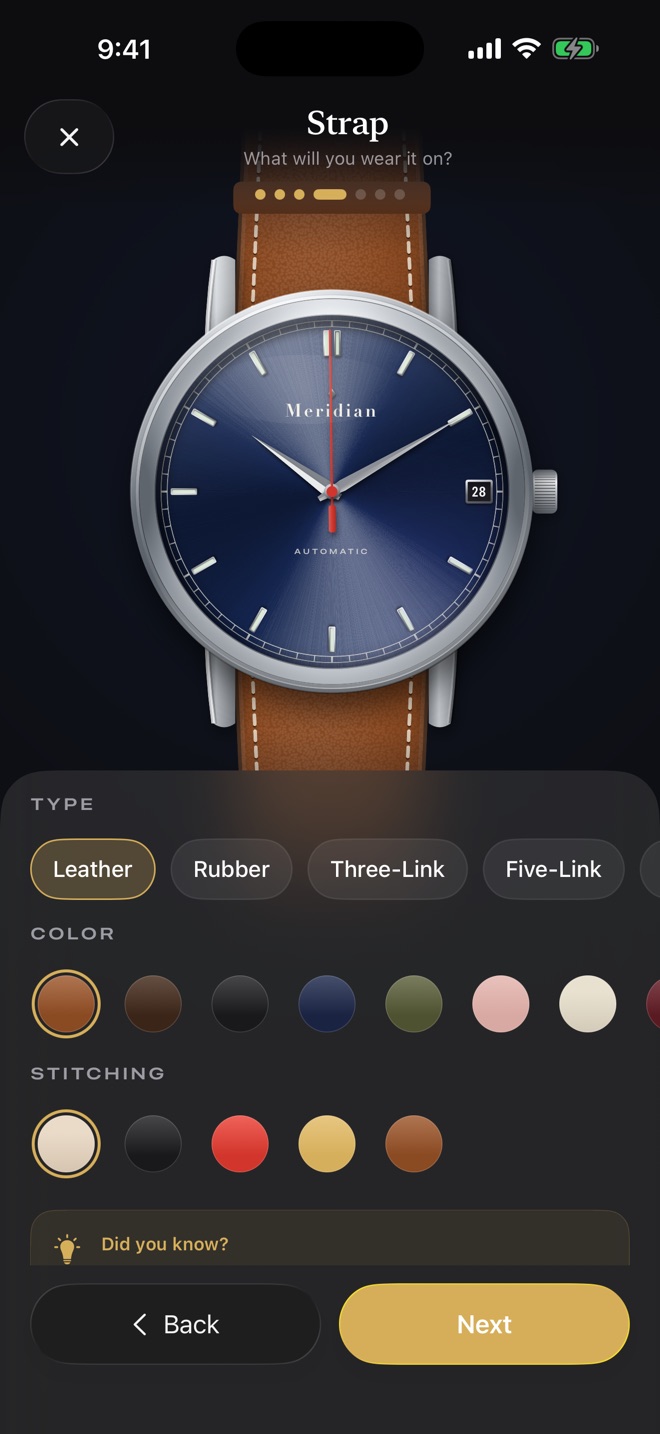
In Mecha Watch you can put your design on leather, rubber, three-link, five-link, rounded link, beads of rice or Milanese mesh, then pick a strap colour — cognac, espresso, black, navy, olive, blush, ivory or burgundy — and even the stitch colour. Straps are always free to change, so you can see how one watch looks five different ways in a minute.
That's the point of the name: Mecha Watch, or said quickly, make a watch. Try the strap before you buy the strap.
Frequently asked questions
How do I know what size watch strap I need?
Measure the lug width — the gap between the lugs where the strap attaches — in millimetres. Common sizes are 18, 20 and 22 mm. Then pick a length that fits your wrist; most straps come in short, regular and long.
Is a leather or metal watch band better?
Neither is better. Leather is lighter, warmer and dressier but doesn't like water. A metal bracelet is durable, water-friendly and sportier, but heavier. Many people own one watch and swap between both.
What is a Milanese mesh strap?
A bracelet woven from fine metal wire, usually steel, using a technique first used for chain mail. It's flexible and adjusts to any wrist size with a sliding clasp.
What is a beads of rice bracelet?
A metal bracelet with rows of small, polished oval beads between the outer links. It's flexible, catches the light and has a vintage look.
Can I put any strap on my watch?
Any strap with the same lug width will attach with spring bars, but the shape and thickness still need to suit the case. Bracelets with fitted end links usually only fit the watch they were designed for.