
Watch hand styles: a guide to 18 types of watch hands
Dauphine, Breguet, Mercedes, syringe, sword and more. What each watch hand style looks like, where it came from, and which dials and cases it suits best.
In this guide
Hands are the smallest parts of a watch you look at every day, and they do a surprising amount of work. Swap the hands on a watch and it can go from dress to diver, from vintage to modern, without touching anything else. If you want to make a watch that looks deliberate, the hands are where a lot of that happens.
This guide covers 18 classic hand styles: what they look like, where they came from and what they pair well with. It ends with finishes, seconds hands and lume.
How to choose watch hands
Three rules get you most of the way:
- Match the mood of the case. Faceted, polished hands suit dress watches. Wide, lumed hands suit tool watches like divers, pilots and field watches.
- Match the indices. Sharp baton markers look best with straight or faceted hands; Roman numerals love Breguet, leaf and spade hands; Arabic numerals pair with syringe, sword and pencil hands. See indices and numerals.
- Get the length right. The minute hand should reach the minute track; the hour hand should stop just short of the hour markers. Hands that fall short make any watch look cheap.
Dress hands
Dauphine. A long, tapered triangle, faceted down the middle so one side always catches the light. Named after the French title for the wife of the heir to the throne, it became a mid-century favourite. Pairs with baton indices, sunburst dials and slim round cases.
Leaf. Also called feuille: a slender leaf shape, curved on both sides and pointed at the tip. Soft and romantic. Lovely with Roman numerals, small cases and mother-of-pearl or enamel dials.
Breguet. A thin shaft with a hollow ring — the "moon" — near the tip. Invented by Abraham-Louis Breguet around 1783, it still signals classic haute horlogerie. Best in blued steel over a cream or guilloché dial with Roman numerals.
Alpha. A tapered hand that swells slightly in the middle before coming to a point. A gentle, 1950s–60s dress shape that works with almost any clean dial.
Lance. A long, narrow spear with a sharp point. Elegant and precise, good on minimal dials where you want the hands to feel light.
Obelisk. Tall, straight-sided and tapering like its namesake. Architectural and a little formal; it suits rectangular and octagonal cases.
Stick. As thin as a hand can be. The Bauhaus idea that less is more: no decoration, just a line. Perfect for minimalist dials with small markers or none at all.
Baton. A straight rectangular bar, slightly wider than a stick. The default modern hand: clean, legible and happy on almost anything.
Tool-watch hands
Sword. A pointed blade, wide in the middle, often filled with lume. Found on pilot, field and dive watches because it's legible at a glance. Pairs with Arabic numerals and dot indices.
Mercedes. An hour hand with a three-spoke circle near the tip. The circle holds a big blob of lume that stays readable underwater, which is why it became a classic diver's hand. Usually paired with a sword minute hand.
Snowflake. An hour hand with a large square lume plot near the tip, made famous by 1970s dive watches. Bold and instantly recognisable. Also paired with a sword minute hand.
Plongeur. French for "diver". The minute hand is huge, often a bright colour, because on a dive the minutes matter most. The hour hand is deliberately small. Striking on a diver with a rotating bezel.
Pencil. Simple, sturdy, lumed and pointed like a sharpened pencil. A staple of field watches since the 1940s.
Broad Arrow. A wide arrowhead hour hand. The broad arrow marked British military property and became the hour hand of early chronographs. Great for bold, vintage-sport designs.
Syringe. A lumed barrel with a thin needle at the tip, like a medical syringe. Common on 1900s pocket watches and revived on vintage-style pilot watches. Pairs with Arabic numerals and linen or matte black dials.
Cathedral. Cut out like stained-glass windows, with an ornate, arched frame. A favourite on early military watches, it gives a field watch a lot of character.
Spade. A spade-shaped hour hand, often paired with a thin "whip" minute hand. It comes from railroad pocket watches, where reading the time at a glance mattered. Looks great with Arabic or Roman numerals on cream dials.
Skeleton. Any hand with its centre cut away, so only the outline remains. Skeleton hands never hide the dial underneath — ideal for busy dials with subdials or a moon phase.
Quick pairing table
| Watch style | Hands that suit it | Typical indices |
|---|---|---|
| Dress | Dauphine, Leaf, Breguet, Alpha, Stick | Baton, Roman |
| Diver | Mercedes, Snowflake, Plongeur, Sword | Dot, Baton |
| Field | Pencil, Cathedral, Sword | Arabic |
| Pilot | Syringe, Sword | Arabic |
| Vintage / railroad | Spade, Breguet, Broad Arrow | Roman, Arabic, California |
| Minimalist | Stick, Baton, Lance | Baton or none |
| Art deco | Obelisk, Leaf, Skeleton | Roman, Diamond |
Hand finishes
The same shape can look completely different depending on its finish.
- Polished. Bright, mirror-like steel. It flashes as you tilt the watch and suits almost anything.
- Blued. Traditional blued hands are heated steel: at around 290°C a thin oxide layer turns the surface a deep blue. It looks spectacular on white, cream and silver dials.
- Gold. Warm, and a natural match for yellow or rose gold cases.
- Black. Maximum contrast on light dials; common on field and pilot watches.
Seconds hands
The seconds hand is the one that moves visibly, so it's where designers like to add a little colour.
- Pencil. A thin, straight needle. Clean and understated.
- Lollipop. A thin hand with a round disc near the tip, often lumed. A classic on divers.
- Arrow. A thin hand with an arrowhead tip, popular on pilot and field watches.
A red, orange or blue seconds hand is an easy way to add one pop of colour to an otherwise quiet dial. On a mechanical watch you'll also notice how it moves: it steps several times a second rather than gliding. How many steps depends on the beat rate.
Lume
Lume is the luminous paint that glows in the dark. Tool-watch hands — sword, syringe, Mercedes, snowflake, cathedral, baton, pencil, broad arrow and plongeur — usually carry it, and it's matched to lume on the indices. Classic green glows brightest; ice blue looks cooler and more modern; "vintage" lume has a warm, aged cream tone that suits retro designs.
Mixing hand styles
The hour and minute hands don't have to match. A Mercedes or snowflake hour hand is nearly always paired with a sword minute hand. Spade hour hands are paired with whip-thin minute hands. When you mix, keep the finish and colour consistent so the two hands still read as a set.
Try every hand style in Mecha Watch
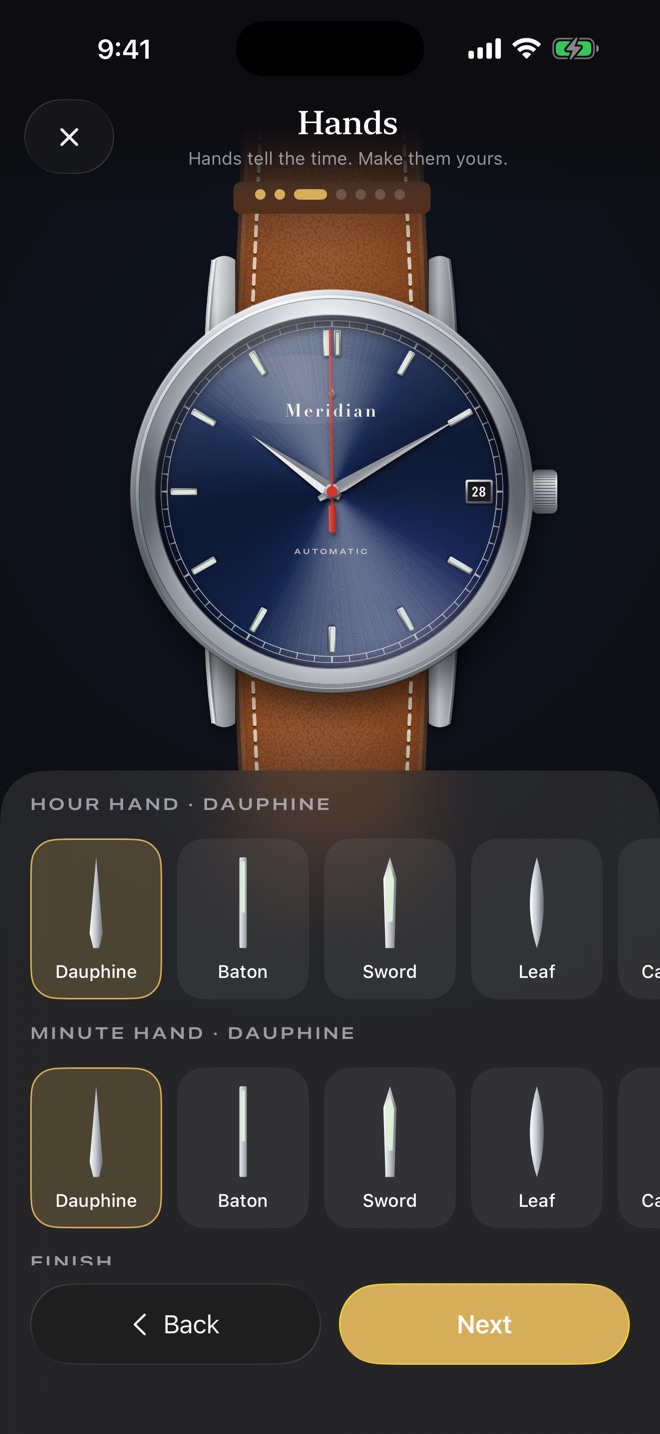
In Mecha Watch you can try all 18 styles on your own design — hour and minute hands can be different styles, and Mercedes and snowflake hour hands pair with a sword minute hand, just like the real thing. Choose polished, blued, gold or black; a pencil, lollipop or arrow seconds hand in red, orange, blue, gold, steel or lime; and classic green, ice blue or vintage lume. Hands are always free to change.
Tap a hand, and a short "Did you know?" note tells you where it came from. It's the quickest way to find out what you like before you design your own watch for real. Mecha Watch — say it fast, and you're halfway to make a watch.
Frequently asked questions
What are the most common types of watch hands?
Baton, dauphine, sword, Mercedes, leaf, Breguet and syringe hands are the most common. Baton and dauphine dominate dress watches; sword and Mercedes are standard on sports and dive watches.
What are Mercedes hands on a watch?
Mercedes hands have a three-spoke circle near the tip of the hour hand. The circle holds a large amount of luminous paint while keeping the hand strong, which makes it very legible underwater. It's a classic dive-watch style.
Why are some watch hands blue?
Traditional blued hands are steel heated to around 290°C, which grows a thin oxide layer that looks deep blue. It also helps protect the steel. Cheaper watches imitate the look with blue paint or coatings.
What are Breguet hands?
Breguet hands have a thin shaft with a hollow circle, or "moon", near the tip. They were invented by Abraham-Louis Breguet around 1783 and are associated with classic, formal watches.
What is the difference between dauphine and baton hands?
Dauphine hands are tapered triangles faceted down the middle, so they catch light on one side. Baton hands are straight, flat rectangular bars. Dauphine feels dressier; baton feels more modern and neutral.