
Moon phase watches: how they work and how to set one
How a moon phase complication tracks the lunar cycle, why the classic 59-tooth disc drifts a day every few years, and how to set the moon phase on your watch.
In this guide
Of all the things a watch can do, showing the phase of the moon is the least practical and possibly the most loved. A small gold moon drifts across a starry window, filling and emptying over a month. You don't need it. But once you've owned one, a plain dial can feel a little empty.
Here's how a moon phase works, how accurate it is, and how to set one. If you want to make a watch with a moon phase, this is everything you need to know first.
What a moon phase shows
The moon goes from new moon (invisible) to full moon and back again in one synodic month — about 29.53 days (29 days, 12 hours and 44 minutes, on average). A moon phase complication shows where we are in that cycle: a crescent, a half moon, a gibbous moon or a full moon, in the same shape you'd see in the sky.
How a moon phase complication works
Behind the dial sits a disc painted with two moons, opposite each other, on a dark blue background. Above it is an aperture with two curved "humps" at the sides. As the disc turns, a moon rises from behind one hump, fills the window, then slides behind the other.
- When the moon is centred in the window, it's a full moon.
- When no moon is visible, it's a new moon.
- In between, the humps cover part of the moon to show a crescent or half.
The classic disc has 59 teeth. Once a day, a finger on the date or hour wheel pushes it forward by one tooth. With two moons on the disc, one full turn is two lunar months: 59 days, or 29.5 days per moon.
How accurate is a moon phase watch?
A 59-tooth disc assumes a lunar month of exactly 29.5 days. The real one is about 29.5306 days — around 44 minutes longer. That tiny difference adds up to one full day of error roughly every 2 years and 8 months. For most owners that's a gentle nudge with the corrector every couple of years.
High-precision moon phases use finer gearing — for example a disc with 135 teeth driven through an intermediate wheel — to get much closer to the true synodic month. Good ones are accurate to one day in about 122 years; the most ambitious designs claim a day in a thousand years or more. They're a favourite way for watchmakers to show off.
| Type | Assumed lunar month | Error of one day after |
|---|---|---|
| Classic 59-tooth | 29.5 days | About 2.7 years |
| 135-tooth "precision" | ≈ 29.5306 days | About 122 years |
| Astronomical (special) | Closer still | Hundreds to thousands of years |
How to set a moon phase watch
Every watch is different, so check the manual — but most follow the same steps.
- Find the date of the last full moon. Any moon-phase calendar or weather app will tell you.
- Advance the disc until a moon is exactly centred in the window. That's "full moon". Most watches use a small recessed pusher on the case side, pressed with a corrector tool or a toothpick (never a sharp metal point). Some use a crown position instead.
- Add one click for each day since that full moon. If the full moon was nine days ago, press the corrector nine times.
- Check the time of day. Many moon phases advance around midnight. As with the date, avoid using the corrector while the watch's calendar gears are engaged — typically from late evening to early morning — unless the manual says it's safe.
If the watch has stopped for a while, you'll need to reset the moon phase along with the date and time. More in how to set a mechanical watch.
Where to put a moon phase on a dial
Traditionally the moon phase sits at 6 o'clock, where it balances the brand name at 12. That's also where a small seconds subdial usually goes, so the two rarely share a dial. Some watches put the moon at 12, or combine it with a date in a larger subdial.
Moon phases look best on dark blue dials, where the gold moon and stars blend into the dial colour, and on dressier cases. A deep blue sunburst or a mother-of-pearl dial is the classic match — see dial finishes.
A brief history
Moon-phase indications appeared on astronomical clocks centuries before wristwatches, when the moon's phase mattered for travel at night, tides and farming. They moved into pocket watches in the 18th century and into wristwatches in the 20th. Today they're almost entirely about beauty — a reminder that a mechanical watch is a small model of the heavens, driven by a spring.
Add a moon phase in Mecha Watch
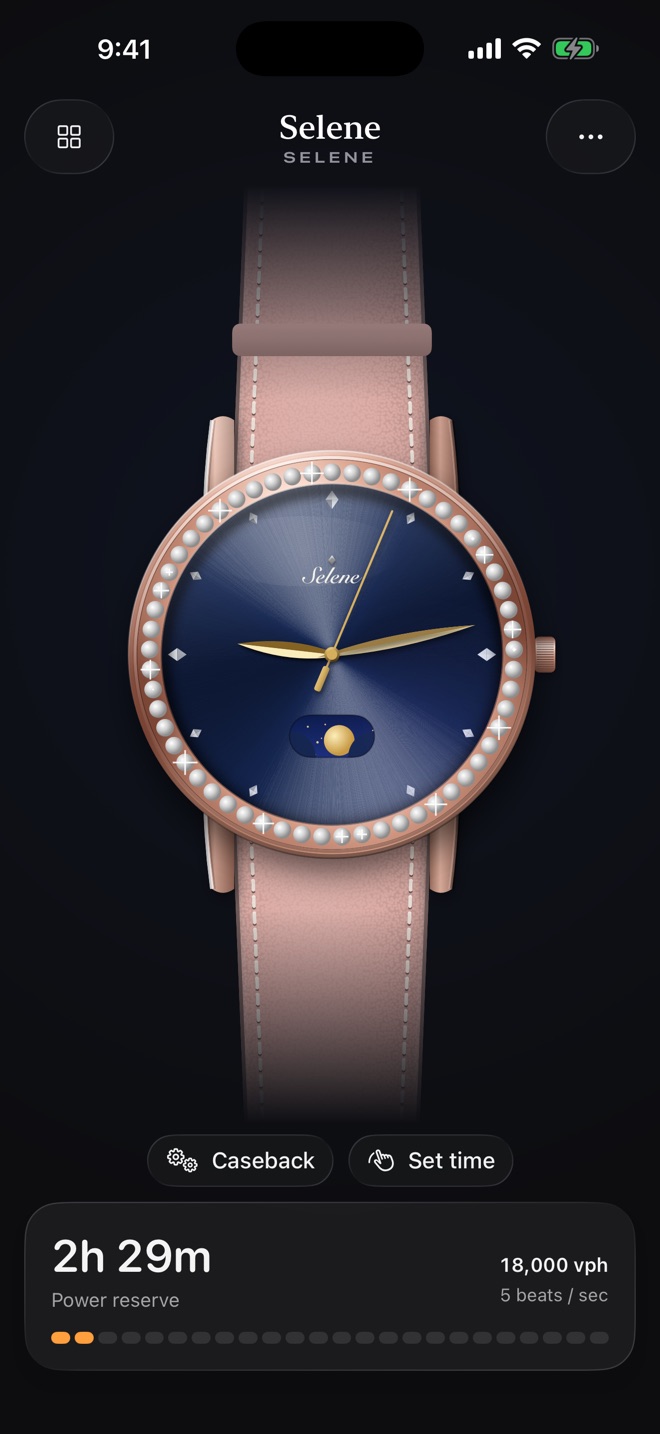
In Mecha Watch you can add a moon phase at 6 o'clock to your own design. Rather than a 59-tooth approximation, the app calculates the moon's real phase astronomically, from the length of the synodic month and a known new moon, so it matches the sky tonight. (It can't share 6 o'clock with a small seconds subdial — just like a real dial.) The moon phase is part of the one-time Mecha Atelier unlock.
Pair it with a midnight-blue sunburst dial, gold leaf hands and a jewel case, and you've made a watch worth looking at under a full moon. Mecha Watch — make a watch, and make it yours.
Frequently asked questions
How does a moon phase watch work?
A disc with two painted moons turns behind a window on the dial. It moves forward one tooth each day, and curved edges on the window hide part of the moon to show its phase. The classic disc has 59 teeth, so it completes one turn every two lunar months.
How accurate is a moon phase watch?
A standard 59-tooth moon phase drifts by about one day every 2 years and 8 months. Precision versions with finer gearing are accurate to a day in about 122 years or longer.
How do I set the moon phase on my watch?
Advance the disc until a moon is centred in the window (full moon), then press the corrector once for each day since the most recent full moon. Avoid correcting while the calendar is changing, usually late evening to early morning.
Why does a moon phase watch have two moons?
So that the disc can turn once every two lunar months. With two moons, one is always either visible or about to appear, and the gearing is simpler.
What happens to the moon phase if my watch stops?
It stops too. When you restart the watch, you'll need to reset the moon phase as well as the time and date.